

Every photographer who travels wrestles with the fundamental tension between capability and weight. The desire to prepare for every possible shot conflicts with the physical reality of carrying equipment through airports, across cities, and up mountains.
Finding personal balance between these competing demands requires honest assessment of actual needs versus aspirational possibilities.
In This Article:
Assessing Actual Versus Aspirational Needs
Honest evaluation of past trips reveals patterns that inform better packing decisions. Review images from previous travels to identify which lenses and equipment actually produced keeper shots.
The results often surprise photographers who packed extensively but relied heavily on a small subset of their gear.
Consider the specific demands of planned destinations and activities. Urban exploration requires different capabilities than wildlife photography or landscape work. Tailoring selections to probable opportunities prevents carrying equipment unsuited to actual conditions.
The single most important piece of gear is the camera that accompanies you everywhere. Many traveling photographers have discovered that a quality compact camera used constantly outperforms elaborate systems left behind due to weight or bulk.
Determining your minimum effective kit enables consistent documentation without burden.
The Case for Minimalism
Traveling light enables photographic opportunities impossible when burdened with heavy packs. The ability to walk all day, climb spontaneously, and move quickly through crowds depends on carrying weight that does not exhaust or anchor you. Energy spent managing gear cannot be directed toward creative observation.
Simplified kits reduce setup time and decision paralysis in the field. Photographers with single lenses spend less time swapping and more time shooting. Embracing constraints often sparks creativity as limitations force novel approaches to familiar subjects.
Security concerns diminish with reduced valuable equipment. Obvious professional gear attracts theft and attention that interferes with authentic street photography. Simple setups blend into environments while comprehensive kits mark photographers as targets.
Building Your Essential Travel Kit
Camera body selection balances image quality, size, weight, and features. Full-frame systems deliver superior results but impose significant weight penalties.
Enthusiast-level crop-sensor cameras and mirrorless systems often provide better travel compromises for most photographers.
Lens selection presents the most consequential packing decisions. Zoom lenses cover more situations with fewer pieces while prime lenses offer superior image quality and smaller profiles.
Many travel photographers settle on a moderate zoom plus one specialty lens matching their primary interests.
Protecting Equipment Without Adding Bulk
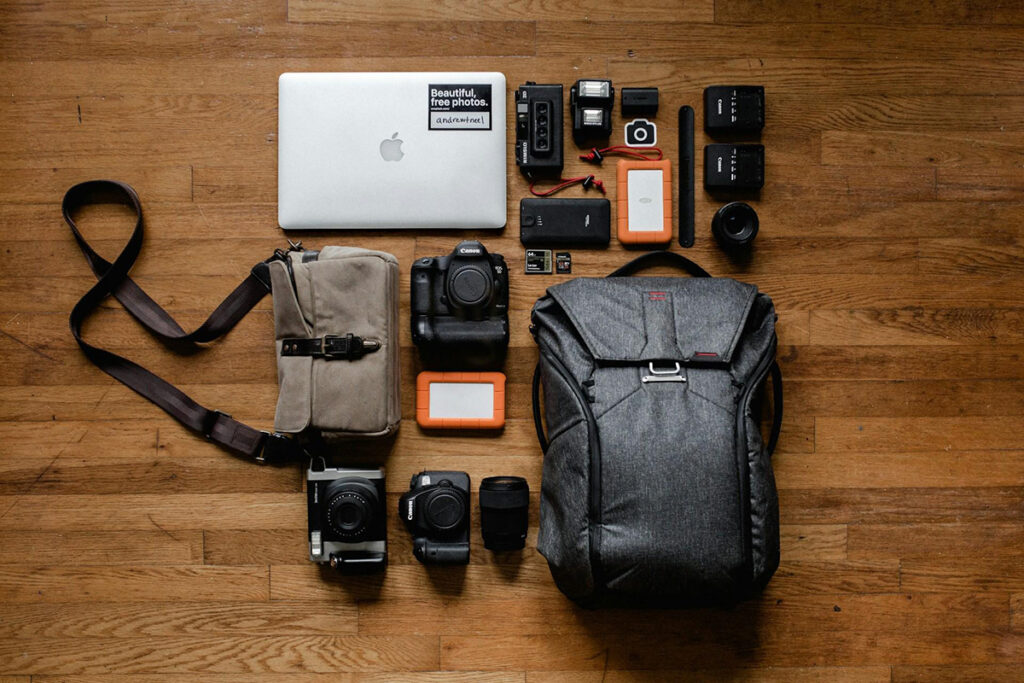
Padded inserts transform ordinary bags into camera protection without dedicated photography luggage that screams valuable contents. These systems offer flexibility to adjust protection based on equipment selections rather than committing to fixed configurations.
Weather protection ranks among essential preparations regardless of forecast. Quick-deploying rain covers add minimal weight while preventing costly damage from unexpected precipitation. Even light rain can destroy electronic equipment in moments.
Insurance provides ultimate protection that no physical measure can match. Documenting equipment serial numbers and values before departure streamlines claims if theft or damage occurs. The peace of mind from adequate coverage may justify its cost, independent of actual claims.
Managing Files on the Road
Backing up your photos is always crucial. When you’re traveling, storage strategy determines whether images survive the journey home. Dual card slots with backup recording provide immediate redundancy. Portable drives offer additional backup locations independent of camera storage.
Cloud backup, when connectivity allows, provides geographic redundancy against theft or disaster affecting all physical storage. Automated upload services handle transfers without requiring manual management during busy travel days.
Curation during travel reduces storage pressure while memories remain fresh. Deleting obvious failures and flagging favorites each evening prevents overwhelming backlogs upon return. This discipline also reveals shooting patterns that inform subsequent days.
The Freedom of Less
The photographer who travels with less sees more, walks farther, and shoots longer than colleagues burdened by comprehensive kits. This freedom translates directly into images as energy and attention flow toward subjects rather than equipment management.
Finding your personal balance requires experimentation and honest assessment, but the reward is photography that captures not just what places look like but how experiencing them felt. That authenticity cannot be achieved with any amount of gear.